Sunday, 9 November 2008

The Wizard of Ars (enal)...


"Arsene knows" goes the popular saying around Emirates stadium. You have to have been a follower of Arsenal Football Club to understand it fully. It is a testament to one of the greatest football coaches of modern times. His appointment, his playing strategy and his transfer policy have all been questioned again and again over the years. Yet, somehow, he has managed to carve out one of the most successful legacies in English football.

Wenger revived the beautiful game in English club football. Wenger brought diet control and no smoking to the players. Wenger won three Premier League titles and four FA cups while a study showed that he was the only manager to make a profit from his transfer activities among the 20 managers in the premier league. One would think- think- that would be enough to not be questioned again and again.

Not in this country. I have written previously about the fickle nature of the British press (Pressure- British Press Wags the Dog). So what do you think happened when Arsenal gave up a 4-2 lead against Tottenham one week and lost an away game to newly promoted Stoke the next? A deluge of newspaper articles appeared questioning the managers methods and wondering if his time is up (Times, Times, Telegraph, Guardian and Sun). How ridiculous!

So as the Manchester United dream team of Rooney, Ronaldo, Berbatov and Tevez all converged at Emirates stadium, it was clear that Arsenal needed a result more than a performance. Fortunately they got both. The second goal in particular, showed the manager's stamp more than individual genius- a 59 second, 16 pass move, in which every one of the Arsenal field players except for William Gallas got to touch the ball. It ended up with a thumping shot in the back of the United net by Nasri- another player plucked by Wenger.

It does not answer all questions about Arsenal's inability to win silverware in the last three seasons. It does not take care of the inconsistency playing bottom teams like Sunderland and Stoke. It does however, answer all questions about whether Arsene Wenger still knows- he does. Let's talk at the end of the season!

Sunday, 2 November 2008

Lewis Hamilton by the Skin of His Teeth


After eight months and 18 races in five continents, with 11 victories between them, as Lewis Hamilton and Felipe Massa crossed the finish line in the fog of battle, both their garages went up simultaneously in a cheer of celebration thinking their man had won the world championship. Indeed, when Massa finished his race in first place, Hamilton was in sixth place needing at least fifth to finish as champion. At the last corner of the last lap of the last race of the season, Hamilton grabbed the fifth place necessary to win the Formula 1 world championship by a single point. It has never been closer in the 58 year history of the sport.

Lewis became the youngest world champion ever, just when luck seemed to be deserting him. Comfortably cruising in the needed fifth position with four laps to go, rain forced the first five to stop for a tyre change. Crucially, sixth placed Toyota of Timo Glock took the gamble and opted to stay out on slick tyres. Hamilton rejoined the race still in fifth but seemed in trouble when Sebastian Vettel of Torro Rosso overtook him with two laps to go. Much as he tried, Hamilton's car simply did not have the grip to reel back Vettel. But just as all hope was given up by the desperate English commentators on ITV, the forgotten Toyota of Glock came into view, struggling badly on slick tyres. In a flash, Hamilton was through and Britain had its first F1 champion in the 12 years since Damon Hill.

Friday, 31 October 2008

Climbing K2: The Hardest Task in all Sports

"There are only three sports: bullfighting, motor racing and mountaineering; all the rest are merely games." Ernest Hemingway

It is easy to forget standing on top of a mountain that the job is only half done. Legendary climber Ed Viesturs famously said, "getting to the top is optional, getting back to the bottom is mandatory". Mountaineers prepare for months and wait years just to take a crack at their target. All for what? A few minutes of taking in the scenery, waving a flag, snapping a photo and hopefully living to tell the tale. On August 1 of this year a record eighteen people managed to reach the summit of K2. Within 24 hours though, 11 of the climbers were dead- not around to tell the tale! (CBS Video).

The physical aspect of these climbs is daunting enough, but that is not the half of it. At these severe altitudes there is only a third the amount of oxygen available compared to sea-level and consequently the brain functions a lot slower. It debilitates your thinking and slows your reactions to the point of making you clumsy. Reaching the summit has its own exhaustion, so descents are even more dangerous and often more deadly. No surprise then that it was on a miscalculated descent, that most of the lives were lost!

If you ask a child to draw a tall mountain, they are most likely to come up with the form of K2. A jagged rock in Northern Pakistan rising steeply from its surroundings, at 8,611 meters (28,251 ft), it is the second highest peak on this planet. Yes, Everest is 800ft higher and better known, but in climbing terms it is simply no match for what has come to be known as "the savage mountain". K2's sharp ridges and icy slopes are steeper and the physical location of the peak makes it prone to severe storms and sudden avalanches. K2 was first climbed in 1954 by an Italian team (original story) and then remained unconquered for the next 23 years. It remains one of three among the ten highest peaks that no one has managed to ascend in the winter. By now 305 climbers have made it to the summit and 77 people have died in the attempt. That's a fatality rate of 1 in 4. By contrast the more popular Everest has been climbed 3,679 times with 210 lives lost- a 5% fatality rate.

There is reason to believe however, that much like the 1996 Everest disaster, made famous in the excellent Jon Krakauer book "Into Thin Air", the recent disaster on K2 involved human error. The various routes up the K2 all converge in an aptly named alley called "the bottleneck". This is where on the night of August 1 at least five different teams merged on their way to the peak. Bad weather had held them from making a push towards the peak for several weeks and the first break saw different teams summit bound at the same time. This resulted in a high altitude traffic jam.

Other factors contributed. Shaheen Baig, the most experienced K2 Sherpa was sent back down the mountain after suffering from altitude sickness. The other Sherpas sent ahead to attach fixed lines on the treacherous part of the climb at the end of the "bottle neck", laid them down too early and ran out of rope on the technically difficult top part. Then, making his way up the ropes, Serbian climber Dren Mandic lost his grip and plunged to his death. A Pakistani porter by the name of Jehan Baig lost his life trying to recover the Serb's body. The resulting delay pushed the summit push into late afternoon, assuring a treacherous descent in the dark. The expeditions should have turned back at this point. Lacking the benefit of hindsight, as well as 66 percent of oxygen feeding their brains, the climbers chose to go on. It would prove to be a fatal mistake.

To compound matters, a serac tore loose on their way back sweeping four more climbers to their deaths and tearing the fixed lines to be used by others in their descent. This trapped 17 climbers above 26,000 ft in the "death zone", known as such because it gets exponentially difficult to survive up there beyond 24 hours. During the nocturnal descent Frenchman Hugues d'Auberede and his Pakistani porter Meherban Kerim lost their footing and both were never found again. A team of three Korean climbers got tangled up in ropes and climber after climber passed them by unable to help. The Irish climber Gerard McDonnell went back to help them and all four died in a slide of ice and snow.

The post-mortem started immediately. Survivor Wilco Van Rooijen speaking from his bed in Combined Military Hospital Rawalpindi told of many different expeditions trying to summit at the same time and having difficulty coordinating with each other. He blamed the commercial aspect of climbing where adventure tourists without adequate climbing skills were showing up to take trophies back home. As a team you are as slow as your worst climber, so it took them twelve hours through the seracs whereas normally it should have taken them four or five.

Unlike the doomed Everest expedition, where the real story only emerged a year and a half later, this one was bizarrely followed in real time by thousands on the blog of American climber Nicholas Rice, who had wisely decided to retreat from the bottle-neck. Modern technology might have changed aspects of how we communicate and spectate, but as far as mountaineering is concerned, it always comes down to man versus mountain- and we know only one of them ever blinks...

Wednesday, 29 October 2008

One Four Seven

It is an achievement to score the maximum possible in any sport. I have previously posted a video of the perfect "nine darter" in darts. Here is Ronnie O' Sullivan scoring the maximum of 147 in snooker.

Sunday, 26 October 2008

Tottenham Coldspurs... Levy-tating in Relegation Zone

Juande Ramos is dead, long live the king. The coach Tottenham poached from two time UEFA champions Sevilla is gone. Sporting director Damien Comolli is dead, long live the king. First team coaches Gus Poyet and Marcos Alvarez are dead, long live the king. The king here is club chairman Daniel Levy and everyone but him is dead, fired, buried.

It's easy to forget that this is the same Levy who let Dimitar Berbatov leave. The same Levy on whose watch Robby Keane and Paul Robinson and Steed Malbranque and Pascal Chimbonda and Radek Cerny left- all members of the Martin Jol "underachieving" squad. Of course Martin Jol was fired as the Tottenham coach when the team finished fifth in the premier league- their best position ever- twice in a row.

Out with the old, in with the new- Ramos and Jol

Then Levy (through Comolli) proceeded to spend liberally on players he thought would elevate the club. In came David Bentley (£15mm), Verdan Corluka (£8.5mm), Luca Modric (£16.5mm), Roman Pavlyuchenko (£14mm), Heurelho Gomes (undisc, approx £10mm) and Giovani dos Santos (£4.7mm). The result saw the Spurs off to their second worst start in history with two draws and six losses after the first eight games.

So out went everyone including the coach, the sporting director, the assistant coach and the trainer. Everyone but the one person singularly responsible for the clubs' operating model (Tottenham have a continental management structure), hiring all the people who were fired and for spending the millions of pounds on new players.

Harry "the Houdini" Redknapp has become the new coach and was celebrated onto the pitch for the first game against Bolton. Its true that there is only one way for the club to go and Harry is also very good at getting the best out of his teams- but so was Ramos before coming to Spurs. The celebrations were even wilder after Spurs won the League cup last year, but the music soon stopped. Harry can pull some magic out of the hat but I am certain he can't get them to finish fifth- where they were with Jol. It defies belief that Levy is being hailed for finding a solution (Harry) to the very problems he created.

Friday, 24 October 2008

Why Tendulkar is better than Lara


Tendulkar or Lara, Lara or Tendulkar? The two highest scorers in test cricket. No doubt they are both great, but who is better?

Let me lay the cards on the table first. As an Arsenal fan I cannot bring myself to cheer Tottenham, and it follows that as a fan of the Pakistan cricket team, I find it difficult to cheer for Indian cricketers. So last week when Lara and Tendulkar were tied at the top of the table for the most career runs, and I knew I had to write this post comparing the two, I was secretly cheering for Lara. The Lara who scored a world record 375, and then when he was overtaken, came back with an unbeaten 400 a decade later. The Lara who made you sit at the edge of your seat because you never knew what was coming the next ball, a slashed four through covers or a snicked catch to gully. But, when I did the analysis, Tendulkar doesn't just beat Lara, he rules him.

There are numbers to compare them with but first there are other factors that must be mentioned. Tendulkar went out to bat each time in the suffocating glare of a billion people. The intrusions, the pressure, the expectation on him for the last 20 years has been immense. And through it all he has been unflappable. Lest we forget, Tendulkar came to public prominence as a 16yr old by putting up a world record unbroken partnership of 664 runs for his school with another 17yr old prodigy by the name of Vinod Ganpat Kambli. Anyone remember him? Kambli averaged 54.2 in 17 tests with 2 double centuries and 2 single ones and then fizzled out and retired by the age of 24. Tendulkar has gone on for another 13 years and still averages over 54.

By contrast when Lara broke the Test and first class record by scoring 375 and 501 within two months in 1994, the resulting fame turned him into a confused and contradictory figure. He fell in and out of love with cricket, fought with team mates and administrators and it didn't help that he played for a losing team. Yes, his 400 not out and 501 are the highest individual scores for Test and First Class matches, but he can statistically rival Tendulkar in little else:


Matches Runs Highest Bat Avg. 100s
Tend 151 11939 241 54.02 39
Lara 131 11953 400 52.88 34

Tendulkar has scored more runs at a higher average with the help of more centuries. That should be the end of the argument. But some Lara supporters argue that Lara played better against the best team of their day, Australia. Also that Tendulkar scored easy runs on flat sub-continental wickets. Well, wrong and wrong.

Against Australia
Matches Runs Highest Bat Avg. 100s
Tend 26 2414 241 54.86 9
Lara 31 2856 277 51 9

Away Averages
Tend 53.70
Lara 47.80

Tendulkar scored at a better average against Australia than Lara did and with the help of the same number of centuries, even though he played 5 less matches. Also, when away from home Tendulkar's average was not only better than Lara's, it fell by fewer runs than Lara's did.

A few last mistakes to set straight then. Lara helped his team win more than Tendulkar did. Well, I looked at their averages for the matches their teams won. Lara 61.02, Tendulkar 62.67. Tendulkar's performance lifted more when winning.

One last nail in the coffin. When are the conditions most hostile for a batsman? When they lose the toss and are sent in to bat. The toss winner clearly making the judgement that the conditions will suit their bowlers and prove difficult for the batsmen. The average for both batsmen when their team lost the toss and were sent in to bat: Lara 34.71, Tendulkar 53.12. Case Closed!

Wednesday, 15 October 2008

Pressure- British Press Wags the Dog

Pressure makes diamonds. Pressure also makes sports stars. It separates the wheat from the chaff, the men from the boys, the champions from the also-rans. How many of us have made that jump shot, that putt, or bowled the yorker on middle stump when we are alone in the play ground? When we are pretending to be watched by the entire world as we shoot the buzzer beater in game 7 or win the masters or a test match against Australia, whereas its just us? Real pressure is different- "when he boasted that he could shoot the stem of a wine glass from a hundred yards, I asked him, can you shoot the stem of wine glass when the wine glass has a rifle pointed at your heart?" That's pressure.


But pressure is not always positive, even for professional athletes. Anyone who saw the Japanese Grand Prix last weekend got a glimpse of how pressure can melt prospective world champions into bumbling bafoons. Contending for their first title, Felippe Massa and Lewis Hamilton drove like teenagers on adrenalin, overshooting corners, hitting each other and other drivers, before finishing 7th and 12th respectively. So if you are cheering for Hamilton, would you construct an environment of pressure around him that would make it more difficult for him to win the championship? For that is exactly what the British press is doing.

The Sunday Times has 24 pages devoted to sports. A recent issue had 20 of those pages devoted to football. There is also a 12 page football supplement on Mondays. The Times has five dedicated sportswriters for football alone. There is also The Telegraph, The Guardian, The Observer, The Independent, Daily Express, Daily Mail, Metro, Evening Standard, Daily Mirror, The Sun, and News of the World that have their own extensive sports sections. How to feed this beast? Where to come up with stories through the news cycles to fill all these pages, to sustain all these journalists?

So when Liverpool plays Chelsea, out come stories about Steven Gerrard switching clubs and going to London. There is then a round of denials, followed by some Chelsea player saying they would love to have Gerrard. The Liverpool chairman is quoted as saying Gerrard is "not for sale at any price". Inter-Milan jumps in with their interest. Reports emerge of a threat to harm his family if he moves from Liverpool. Why he doesn't replicate club form for country starts becoming a topic again. Can he play with Lampard? Should he be center of mid-field, left of mid-field, or in a forward role behind the striker? You are starting to get the picture.

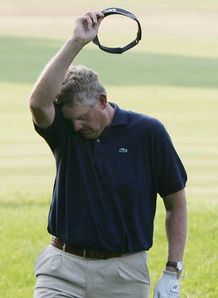
Before long he feels the pressure. Every time he steps on the pitch he feels the pressure. Every time he has a bad day at the office, the pressure multiplies. One of the greatest mid-field players in the world is questioned again and again until perhaps he himself starts believing the press and becomes a shadow of the player he can be whenever he dons the national colours. Tim Henman probably felt the same pressure every time he stepped onto the hallowed grounds of Wimbledon. It's probably not a coincidence Colin Montgomery won eight European Orders of Merit and still kept striking out every time he was in contention for a major.

In Italy there is a newspaper dedicated to sports called "gazetta dello sport", but the broad sheets like La Repubblica or Corriere della Sera devote no more than 4 to 6 pages to sports. Le Monde in France usually gives 2 pages to sports. Will British athletes start performing better if there is less attention from the press? Interesting question, but I don't think we'll ever find out.