Sunday, 12 October 2008

England Plays Football Inspired by Borat


The score line will show England 5, Kazakhstan 1, but this was no victory to be proud of. Hold the champagne, Kazakhstan is ranked 131st in the world by FIFA and any championship team, let alone a premiership team, should have dispatched them off with ease. Instead, the all-star England team pottered around for almost an hour before opening their scoring account and even then gave off the impression of a lack of confidence.

England Fans expect their team not to just qualify for the World Cup but to win it. This was not a performance to base much hope on though. The attack was toothless for the first hour but even the defense was shaky and to allow Kazakhstan not only to score but to take as many shots on goal as they did was not promising. Brazil or Portugal or Holland would have carved up the England defense with ease today.

But Capello is a competent manager and will surely look to remedy the situation. This was an important game in terms of qualification but sometimes it is hard to gee yourselves up before weak opponents. We'll give them the benefit of doubt but there continue to be persistent problems that need to be addressed: playing Gerrard and Lampard together, finding a stable strike partner for Rooney, and (as mentioned before) keeping the well paid stars focused on their jobs.

Thursday, 9 October 2008

Glass Chin- the Uncurable Problem


A "glass chin" simply refers to a boxer's inability to tolerate physical trauma to the face without getting knocked out. While there are various theories about why a boxer has a glass chin (weak neck, questionable mind-frame, slight legs), there has been virtual unanimity about the lack of its cure. "You can't train a chin", says Angelo Dundee, famed trainer of Muhammad Ali. You can pump iron, run marathons, spar with many partners, but you can't improve your chin- you are born with it.

Some great boxers like Lennox Lewis and Wladimir Klitschko were reputed to have glass chins and the reputation stayed with them. Others like heavy weight Oliver McCall became famous for taking punishment but never falling. So the biggest mystery in boxing has been, can you ever improve a glass chin?

Well, we are about to find out the answer. British hope Amir Khan, carefully stringing together an 18-0 record for an assault on the light weight title, recently confirmed fears about his "glass chin" when he was knocked out in 54 seconds by Colombian Breidis Prescott (video). At risk are the millions he and his promoters were set to earn from his success. So his new trainer, in a controversial move, is taking him to Los Angeles to put him through "martial arts techniques" that will "deaden the nerves on the jaw". Good luck! There are martial arts techniques using blows to shins and feet and to the body to toughen them up. Are they going to beat his chin with a stick?

It might be more useful to work on Khan's defense techniques, make him more conservative in his style so he's not exposing and leaving himself vulnerable to sucker punches. It is the sudden acceleration and rotation of the head that causes a disconnect in the brain, according to research I've done on the internet in the last 30 minutes. The ability to absorb that is neurological and seems something you are born with, or without. Maybe Khan's trainers need to spend time researching on the world wide web, instead of in a gym in Los Angeles.

Wednesday, 8 October 2008

Celebrating 1000

I am celebrating one thousand unique visitors to Sportz Insight today, within one month of starting this blog. I truly thought it would just be a place to share some private thoughts with some close friends. Now I do wish the comments section was used more so this blog became more interactive. It does encourage the writer to keep going.

The surprise for me has been that often the story written looks nothing like the one started. Interestingly, that especially seems to be the case for the five most popular stories so far (measured by hits, ratings and links). Here are links to the most popular stories for those who just discovered this blog:

1. Nawakille: A Squash Town You've Never Heard Of
I wanted to write about Jahangir Khan, and in the process discovered that Jansher Khan was from the same village...

2. The Haka
The consummate Kiwi Patrick Mullins urged me to write on Rugby, and I know absolutely nothing about Rugby, so after three discarded drafts, this was the best I could do...

3. Money Can't Buy You Love- But Gold Medals is Another Matter
I wanted to write about foreign players in the premiership, and then got diverted in my research...

4. Fiercest Rivalries in Sport
Spurs vs. Arsenal was the topic when I started. Two days later, the rivalry didn't even make the cut...

5. The 5 Most Memorable Ads on TV
The Nike cricket Ad never made the cut...

5. Why Athletes Find it Difficult to Stay Retired
I wanted to bemoan Lance Armstrong's return, and then figured he's not that different to other greats...

Thanks for reading.
Faisal

Tuesday, 7 October 2008

Lies, Damn Lies and Statistics


Sampras and Agassi, Palmer and Nicklaus, its always easy to compare rivals when there are two of them. Cricket in the 1980s was blessed with four swash buckling all rounders who could all lay claim to being the greatest of all time- Garry Sobers excluded, because he really has a better record than all. Ian Botham (102 tests), Kapil Dev (131 tests), Richard Hadlee (86 tests) and Imran Khan (88 tests) formed the quartet of outstanding all rounders. So impressive were their contributions that they have generated a vociferous fan base and any discussion comparing their achievements is almost always shadowed by emotion.

So in typical fashion, I thought of settling the argument by statistics so I borrowed some figures from cricinfo and from the statistical blog It Figures. Here are the results:

The first cut is to look simply at the difference between the batting averages and the bowling averages. Imran's relatively high batting average helps him out here.
No. Player Ctry BatAvg BowlAvg Diff
3 Imran Khan Pak 37.69 22.81 14.88
8 Botham I.T Eng 33.55 28.40 5.15
9 Hadlee R.J Nzl 27.17 22.30 4.87
12 Kapil Dev Ind 31.05 29.65 1.41
The second cut was a longevity based measure, which equates each wicket to 20 runs scored and sums up total runs in their careers. Kapil and Botham are helped here with their longer careers.
No. Player Ctry Runs Wkts Allruns
2 Kapil Dev Ind 5248 434 13928
3 Botham I.T Eng 5200 383 12860
6 Hadlee R.J Nzl 3124 431 11744
8 Imran Khan Pak 3807 362 11047
Another valid measure should be outstanding individual match performances with bat and bowl. On the batting front it seems like Botham comes out ahead while on the bowling side Hadlee has the edge.
No. Player Ctry75+run/4wkt 100s Bowl SR
2 Botham I.T Eng 11 14 56.9
8 Imran Khan Pak 5 6 53.7
12 Kapil Dev Ind 4 8 63.9
18 Hadlee R.J Nzl 7 2 50.8
The conclusion?
Batting: Botham and Imran seem strongest in batting (former having bigger scores, latter with higher average).
Bowling: Hadlee seems to be the best bowler, with Imran a close second (average and strike rate)
Longevity: Kapil survived the longest and outscores them all in total runs and wickets.
The answer to this one, we'll leave everyone to form their own conclusions and share with us in the comments.

The Greatest!

"I know where I'm going and I know the truth and I don't have to be what you want me to be. I'm free to be what I want." Muhammad Ali
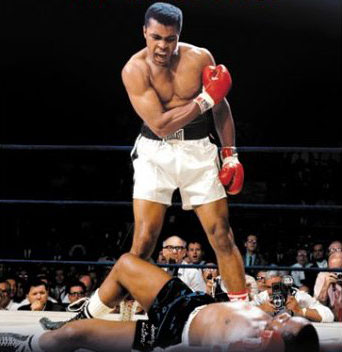
"What's my name?"

When something has been done once, its never the same to do it again. After you have seen an Andy Warhol, making art out of soup cans is not impressive. After you have run the four minute mile, no one can break that barrier again. Who knows the name of the second person on the moon, the second to summit Everest, the second to fly an airplane? There is a different, untrodden path that pioneers take and there in lies their greatness. That is what makes Ali the most inspirational sports star of all time. He did things that no one else had done, and he did it in a manner no one else had even thought of. He invented come backs before Michael Jordan. He invented rap before Run- DMC. He invented self-promotion before Donald Trump. And he questioned the war before there was an anti-war movement.

Along the way, he won the Heavy Weight Championship of the world an unprecedented three times while being banned from boxing for three and a half years at the peak of his career (before beating Frazier and Foreman and Spinks). He also changed the nature of the sport. Boxing before Ali was a slug fest, where energy was conserved and big hits won fights. Along came Ali, with dancing feet, glancing hands and a mouth that simply could not be shut. He won fights by getting in the minds of his opponents before the first punch was thrown. And then for good measure, he got in the ring and dazzled them with his movement, with his ability to absorb punishment, and if all else failed by opening a can of whupass on his opponents. He was a thinking fighter, before thinking in the ring was fashionable.

Those of us who have seen Ali fight might remember him by his fights with Larry Holmes or Trevor Berbick (his last two), but Ali as a fighter should not be judged by those. I have written about how nearly all great athletes find it difficult to retire, and Ali, financially bled by a posse of hanger-ons was no exception. But this was the same champion who initially won the heavy weight title of the World as a 7 to 1 underdog to Sonny Liston. He was then known as the "Louisville Lip" for his brash predictions that he will "float like a butterfly and sting like a bee", a phrase still known the world over 43 years later. The title picture above, Ali's most famous, is paradoxically from the rematch with Liston where Ali was booed. Liston had refused to acknowledge him as Ali and kept calling him by his old name of Cassius Clay. Ali is infamously asking Liston "what's my name?".

A few victories later Ali got prosecuted by the government for refusing to fight in Vietnam and lost his boxing license for three and a half years. He famously explained, "I ain't got no quarrel with them Viet Cong... They never called me nigger." He was reinstated in 1974 and lost the "fight of the century" to Joe Frazier. He then spent another three years trying to get a shot back at the Heavy Weight crown. Along the way he beat Frazier and split two fights with Ken Norton. Then at the age of 32, he got his chance against the hard hitting George Foreman in the famous "rumble in the jungle" in Zaire. Foreman had knocked out both Frazier and Norton in two rounds each, while Ali had not been able to knock either boxer out in over 50 rounds. Ali went in as a big underdog but pulled the rope-a-dope on Foreman and won the Heavy Weight crown for the second time.


After a few title defenses, Ali then had his decisive third fight with Frazier, known as the "Thrilla in Manilla". This was perhaps his greatest fight yet (and his fiercest rivalry). Ali won but fittingly fainted on the canvas afterwards. Perhaps he should have retired by now but he defended his title another six times before losing it to Leon Spinks in 1978. Then he famously won it back to become the first Heavy Weight Champion ever to win the title three times. His fight with Larry Holmes in 1980 should not ever have happened on medical grounds. A complete medical at the Mayo clinic revealed he had difficulty with muscles involved in speech, early signs of Parkinsons. But commercial interests prevailed and the rest is history.

It is not possible to understand his legacy without knowing how unpopular Ali was in his early fighting days, for joining the black Muslims, for oppossing the war, for being anti-establishment. Before his very first shot at the title with Liston, fight promoter Bill McDonald threatened to cancel the bout if Ali did not denounce the black Muslims. After fighting his whole life to get a crack at the title, Ali did not even flinch. He had no intention of renouncing his new religion. It got worse. When he fought the deeply Catholic Floyd Patterson, it became a religious war and the brash Ali prevailed and was widely reviled. It got worse. Ali refused to join the army. The Chicago Tribune ran eleven anti-Ali draft stories in a single issue. There were all kinds of stories of the army trying to cut a deal with him in exchange for induction; to let him defend his title and put on exhibition fights. But Ali did not budge. He lost everything, including three and a half years of his fighting prime, just to stand up something he believed in. Not many people did that.

In his journey he became perhaps the most known face on earth. He had a following from Asian dictators to African village children to the biggest statesmen in the world. As an aged dethroned champion, when he couldn't light up the ring anymore, when Parkinson's didn't leave him even with control of his own faculties, it would have been all too easy to spend his time at home in Louisville. But he used his popularity and became a UN messenger for peace. He traveled all over the world, lending his name to hunger and poverty relief, supporting education and promoting adoption. Even the last few years, severely restrained by Parkinson's, Ali has still traveled for these worthy causes an average of 200 days a year.

Sure, there can be an argument between Ali and Joe Louis as the Greatest Heavy Weight Champion of all time, but there can be never be an argument, that as a sports star, who is "the Greatest".

Saturday, 4 October 2008

Do Humans have Limits?


Can human's improve for ever? Can we keep running faster, jumping higher, throwing farther? Or is there a limit to our improvement? I saw this interesting chart in the Economist a few weeks ago that showed that while the men's 100m sprint time has improved by 9% in the last 100 years, the swimming 100m time has improved by 28%. Given human limits, we would expect the record curves to start flattening out as time goes (asymptotic for you math geeks), but it appears the running times will stop improving long before the swimming times. Why is that?

Lets first try to get a grip on why running times have improved so far. Apart from more scientific training, commercial and sponsorship opportunities have afforded athletes to become dedicated professionals. They can hire mental and physical coaches, physiotherapists, form trainers and depend on video analysis. Also, athletes can relax about their economic well being and focus on their "job", while even previous greats like Jesse Owens had to resort to racing horses to make money.

So while improvement in running appears primarily due to physical conditioning, plummeting swimming records seem to owe much more to vastly better understanding of bio-mechanics and human hydrodynamics. Swimmers are now coached to take longer strokes and to stay under water longer after turns. Technological progress like the new LZR Speedo suit seems to have contributed its share too. The answer to why we can improve more in swimming than running might just be the product of our evolution. We simply have more to learn about how to swim than about how to run.

Thursday, 2 October 2008

"The Dirtiest Race in History"


The image is burned in the mind of everyone who saw it. It was the 100m final at the Seoul Olympics and a muscular Ben Johnson impetuously raised his right arm and powered ahead of the greatest 100m field ever assembled (video). We looked astonishingly at the stopped timer on the bottom right of the screen showing 9.79 seconds- a new world record. For the first time in history, four runners in the same race had run under 10 seconds.

Even more stunning news came two days later when Ben Johnson was unceremoniously stripped of his gold medal and the world record. He instantly became the black hole of all criticism, becoming the poster child of everything wrong with world athletics. Only now, we know that 5 of the 8 finalists failed a drug test and Carl "zero tolerance" Lewis himself should have been banned for two years for testing positive for stimulants at the US Olympic trials two months earlier. Linford Christie tested positive along with Dennis Mitchel and Desai Williams.

It appears however, that the US Olympic Committee did not apply the same standards it expected of the rest of the world. It appears the only reason US athletes did not get caught back then was because the USOC covered up for them. And the only reason we know this is that the former head of US anti-doping programme became a whistle blower and chose to release 30,000 pages of documents a few years ago.

It is in this light that Carl Lewis' latest rant casting aspersions on Usain Bolt are especially bothersome. After questioning Bolt's improvement, he went on to proclaim, “I’m proud of America right now because we have the best random and most comprehensive drug-testing programme. Countries like Jamaica do not have a random programme, so they can go months without being tested. No one is accusing Bolt, but don’t live by a different rule and expect the same kind of respect. How dare anybody feel that there shouldn’t be scrutiny, especially in our sport?”

Where was Carl Lewis when all the Americans were winning the sprints? Where was Carl Lewis when Americans (including himself) were testing positive and the USOC was shielding them? Where was Carl Lewis when the Balco scandal broke? When Justin Gatlin and then Tim Montgomery and Marion Jones returned their three Olympic golds for testing positive. Was that in Jamaica? Where has Carl Lewis been?